
Vibration Damping vs. Vibration Isolation: Choosing the Right Strategy for Noise & Vibration Control
In advanced acoustic engineering and noise-control systems—such as those addressed by Soundcoat’s materials and services—the distinction between vibration damping and vibration isolation is critical. While both aim to reduce unwanted vibration (and its consequent noise), the methods, mechanisms, and applicable situations differ significantly. Understanding the nuance helps OEMs, specifiers, and engineers choose correct materials, design effective systems, and articulate benefits clearly when dealing with structure-borne noise, resonant panels, equipment enclosures, or heavy-duty vehicle frames.
What Is Vibration Isolation?
Vibration isolation is the practice of reducing the transmission of vibrational energy from a source to a receiver by physically decoupling them or inserting compliant/resilient elements in the path. In effect, rather than absorbing the vibration energy within a structure, isolation seeks to prevent that energy from reaching the structure in the first place.
Key features of isolation:
- Isolation operates through elements such as springs, elastomer mounts, air-mounts, resilient pads, or other isolators designed to shift the system’s natural frequency well below the excitation frequency.
- It is commonly used at the interface of the vibration source and the supporting structure (for instance, engine/motor mounts, machine bases, equipment racks) so that the structural carrier doesn’t receive the source vibrations.
- The performance metric often used is transmissibility, defined as the ratio of output vibration to input vibration. Lower transmissibility means better isolation.
- Vibration isolation in the acoustics context: by isolating the vibrating source (or structure) you also reduce the chance for structure-borne vibration to radiate airborne noise through other components or walls.
Isolation Example: Imagine a semiconductor vacuum pump mounted on an elastomer isolator platform. The pump’s vibratory energy is largely kept from the equipment floor or supporting structure via the isolator. Then, if the enclosure panels still vibrate, you might apply damping treatments to the panels themselves (more on that next).
What Is Vibration Damping?
Vibration damping refers to mechanisms that dissipate or remove vibrational energy within a structure or element once vibration has been excited. Rather than simply preventing transmission, damping takes the vibration energy and turns it (typically) into heat or internal friction, reducing amplitude, resonance magnitude, and therefore, radiated noise.
Key features of damping:
- It uses materials and treatments such as viscoelastic layers (like as GPDS), constrained-layer damping composites (such as DYAD, Soundfoil LT, or Soundfoil RT), damping coatings, or laminates to absorb vibrational energy.
- It is typically applied to vibrating panels, housings, chassis, or structural members that are already subject to vibration, and you want to reduce their vibratory response and consequent radiation of noise.
- It influences resonance behavior: by increasing the damping factor (loss factor) of the structure, you reduce the amplitude of resonant peaks, lower Q-factor, and reduce radiated noise.
- Vibration damping in the acoustics context: a panel treated with damping will vibrate less and therefore radiate less airborne sound, particularly structure-borne noise.
Damping Example: Consider the metal housing of a EV-charger kiosk that resonates at a certain frequency due to transformer hum or switching noise. Applying a constrained-layer damping composite between the panel and an outer skin increases internal friction, thus reducing vibration amplitude and sound radiation from the surface.
When to Use Each (and How They Complement Each Other)
In many real-world acoustic/vibration control systems, both isolation and damping are used — they’re not mutually exclusive but rather complementary. Understanding when to deploy each is key.
When to use isolation:
- When the goal is to separate the vibrating component (e.g., motor, pump, compressor) from the surrounding structure (floor, frame, support).
- When the source has high force and you want to prevent transmission into structure-borne paths.
- When you have an excitation frequency and you can design the isolator such that its natural frequency is well below the forcing frequency, maximizing attenuation.
When to use damping:
- When you have structural components or panels that are excited (by vibration or acoustic coupling) and you need to reduce their vibrational response or radiated noise.
- When resonance or high-Q behavior is causing undesirable amplification of vibration/noise.
- When modifying the source or transmission path is impractical and working on the vibrating structure itself is the appropriate route.
How they work together:
- Use isolation at the source support to reduce transmission into the structure.
- Use damping on the structure or enclosure panels to reduce residual vibration and noise radiation.
- By combining both you can achieve significant noise/vibration reduction across both structure-borne paths (via isolation) and radiated sound paths (via damping).
Image courtesy of Shutterstock
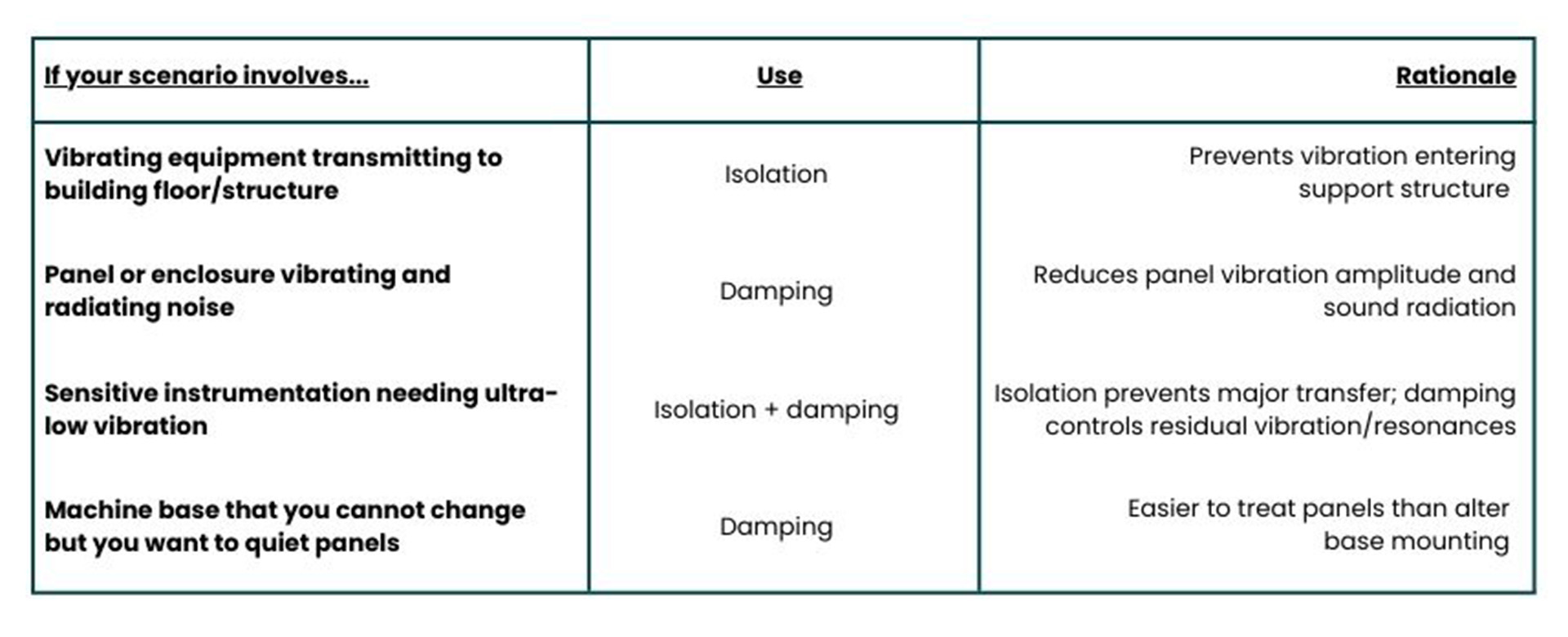
Practical guide for when to use vibration isolation, vibration damping, or both.
Conclusion & Key Takeaways
- Distinguishing between vibration damping and vibration isolation isn’t just academic — it materially affects how engineers design, specify and purchase solutions for noise and vibration control.
- Vibration Isolation = decouple & prevent transmission of vibration energy from source to receiver.
- Vibration Damping = dissipating vibration energy within a structure to reduce response and radiated noise.
- Use isolation when looking at support mounts, equipment bases, and resilient connections.
- Use damping when looking at panels, housings, structural elements that are already vibrating and radiating noise.
- In many cases both are needed for optimal performance: isolate the source, damp the structure.
How Soundcoat Can Help
Noise source & intensity identification: Through our acoustic testing capabilities, we can perform a variety of testing services on noisy equipment, employing tools such as our acoustic camera for real-time acoustic field visualization, or sound intensity and sound power calculations with our Brüel & Kjær sound intensity probe.
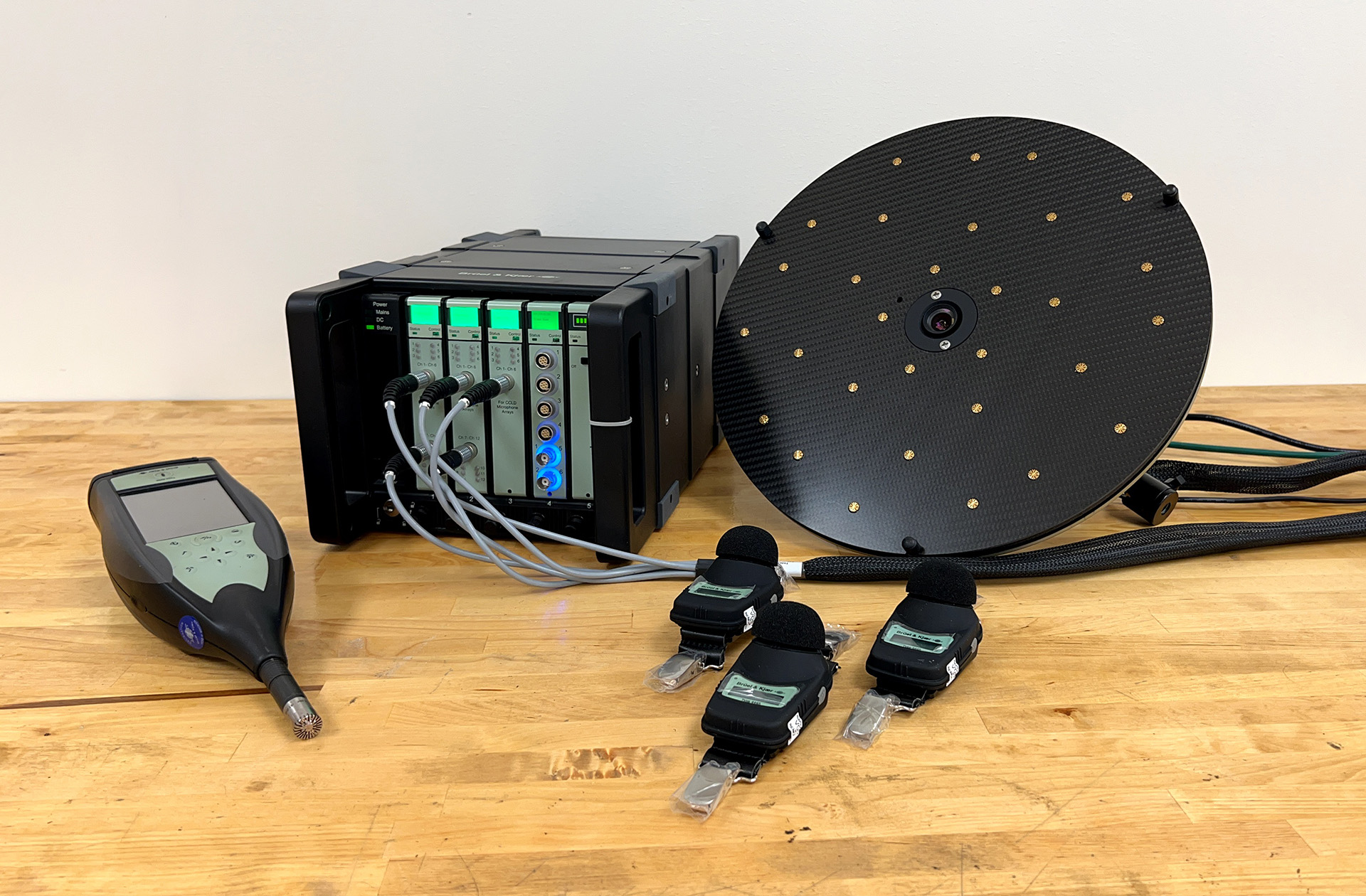
Soundcoat’s B&K sound intensity probe and sound camera array. Soundcoat © 2024
Materials sourcing: Our portfolio of materials delivers the performance needed to prevent or reduce vibrational response. Whether individually with something like DYAD for aerospace applications, or with laminated materials like the Composite: Foam Damping Sheet for power generation applications.
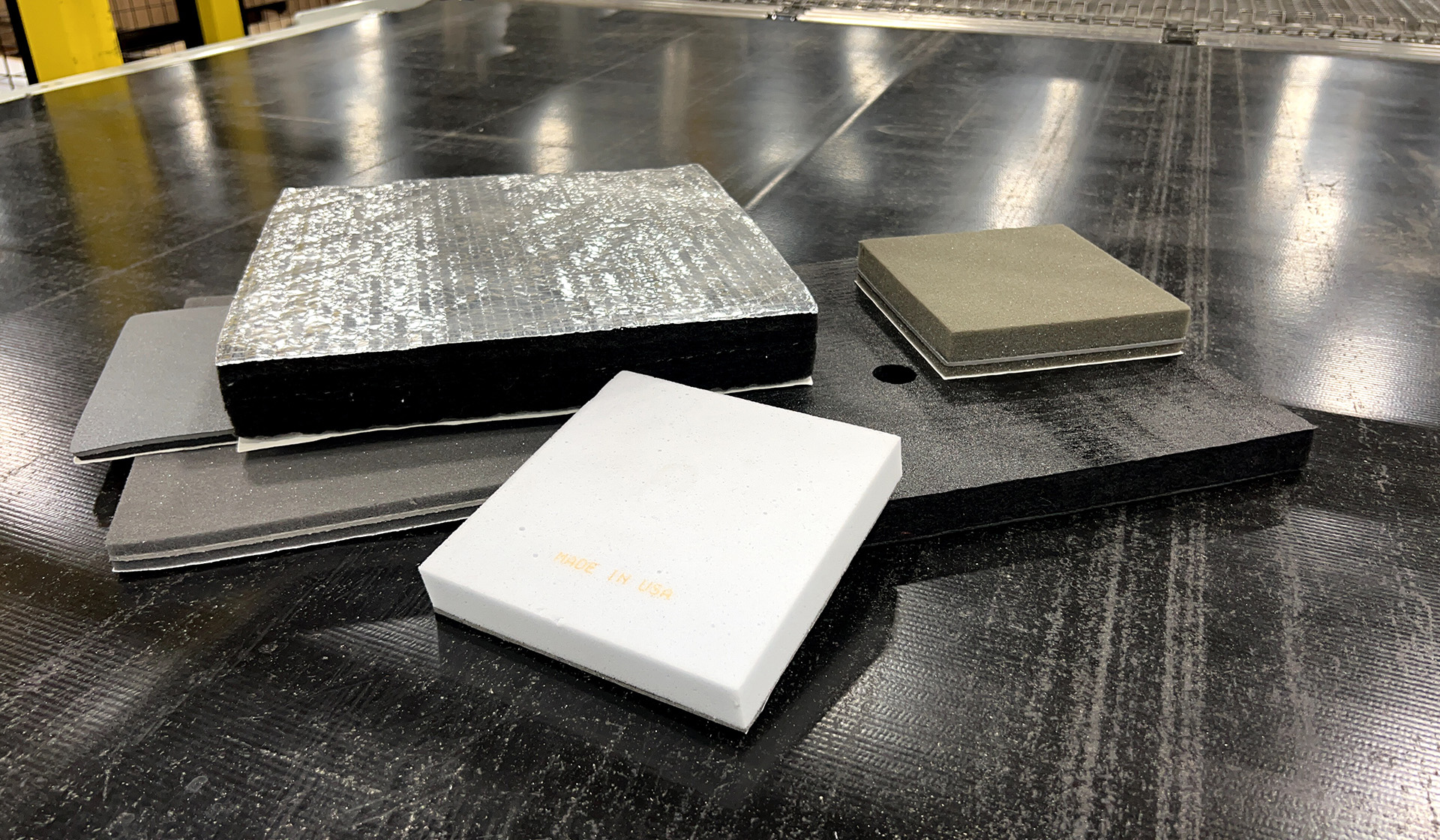
A variety of composite materials manufactured in the Deer Park, NY facility, which also houses the acoustics lab. Soundcoat © 2024
Rapid prototype manufacturing & testing: With our onsite production capabilities, we can quickly produce material solutions and test them in our acoustics lab. The in-house proximity allows for quick adjustments and re-testing to validate and optimize the material solutions. Head over to our Case Study on Acoustic Testing for Medical Equipment to see how we helped a national company do exactly this.
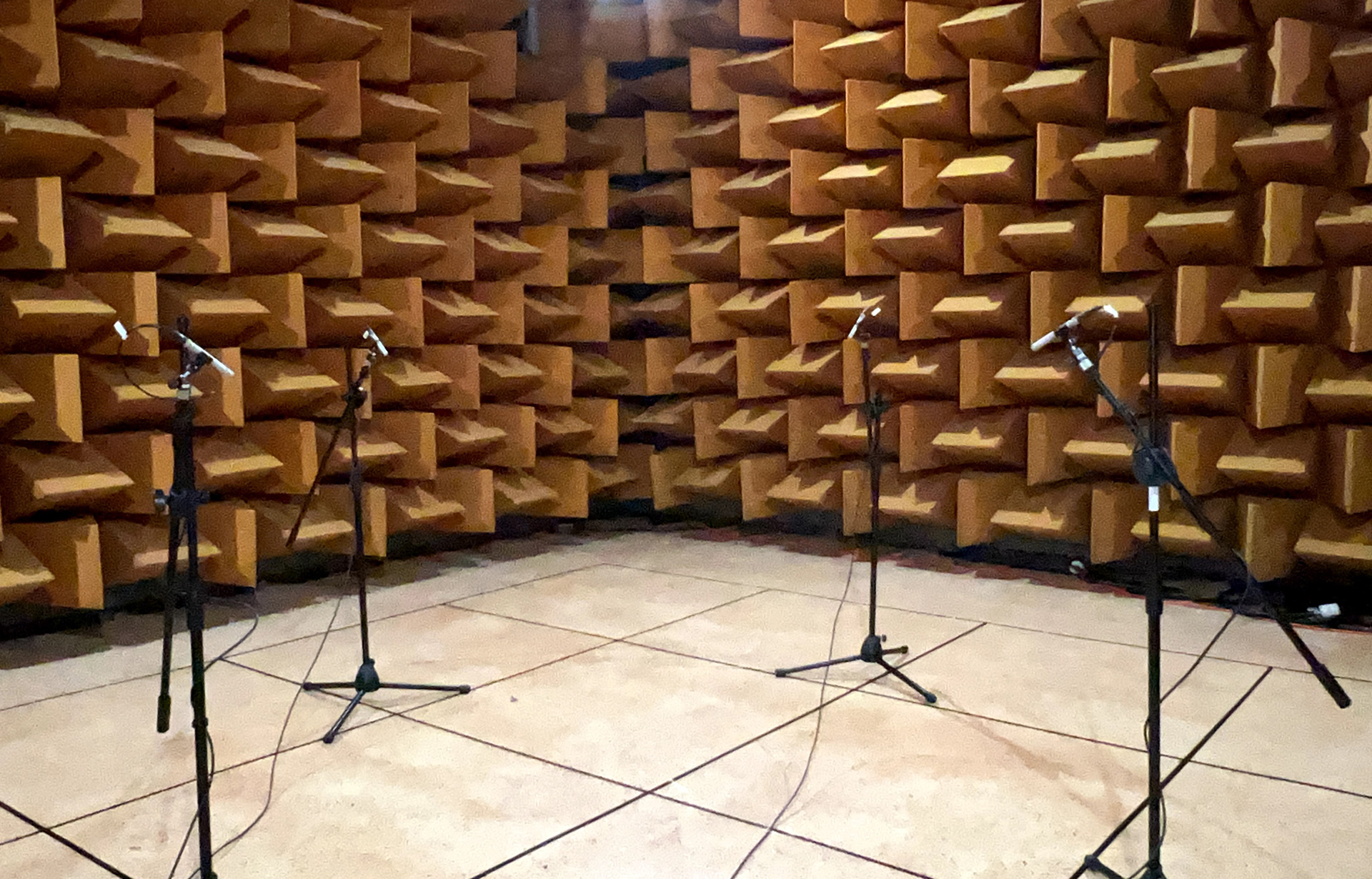
Inside the hemi-anechoic chamber in the Soundcoat R&D lab, Deer Park, NY. Soundcoat © 2024
Sources & References
Brüel & Kjær. Fundamentals of Vibration and Damping. Technical Note BU-0229, 2019. https://www.bksv.com/downloads/svpockethandbook/index.html
Cremer, L., Heckl, M., & Ungar, E. E. Structure-Borne Sound: Structural Vibrations and Sound Radiation at Audio Frequencies. Springer-Verlag, 1988. https://link.springer.com/book/10.1007/978-3-662-10121-6
Harris, Cyril M. Handbook of Acoustical Measurements and Noise Control. 3rd ed. McGraw-Hill, 1991. https://www.biblio.com/book/handbook-acoustical-measurements-noise-control-harris/d/1702077227?srsltid=AfmBOoomICvkvRTgwuhHtKjIKg0S_JOSHM8QjbsKusZJeo9wiEP9qinR