
How to Reduce Noise in a Large Industrial Space (Distribution Centers and Manufacturing Facilities)
If you’ve ever walked into a manufacturing plant or distribution center and had to raise your voice just to be heard, you already know the problem. But here’s what most facilities and their managers miss: industrial noise isn’t just an annoyance—it’s a performance issue, a safety concern, and eventually, a people problem.
After working across diverse industrial facilities—with decades of combined experience in noise reduction materials and hands-on acoustic testing—we’ve seen what actually works (and what doesn’t). Let’s break it down.

Top: Package handling employees removing packages from distribution center conveyor belt.
Above: Plastic package bin rattles across motorized metal conveyor rollers.
Why Noise Becomes a Problem in Industrial Spaces
Facilities are normally built for throughput, efficiency, and durability—not sound control. Then what happens?
- Multiple machines run simultaneously
- Hard surfaces (concrete, steel) reflect sounds
- Noise builds up and lingers (reverberation)
- Speech becomes harder to understand
- Noise thresholds are exceeded
From there, two main drivers usually push companies to act:
1) Worker safety concerns
2) Employee complaints
And by the time complaints start stacking up, the issue is already impacting productivity, morale, and communication.
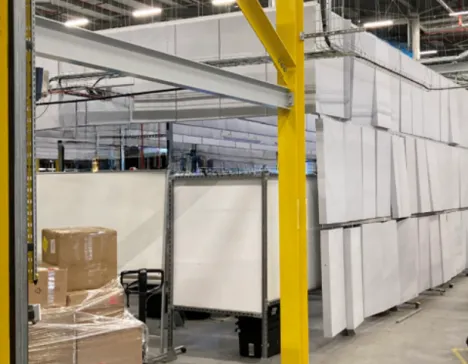

Left: Raw foam panels hanging around a workstation in an attempt to quiet the factory noise.
Right: Acoustic blankets hung from the ceiling in an attempt to block and absorb mechanical noise.
One of the Biggest Mistakes We See
If there’s one thing we see over and over again, it’s hanging "sound absorbing" materials like raw foam or acoustic blankets randomly and hoping those fix the noise problem. They won’t. Why? Because industrial noise is rarely coming from just one place. It’s typically a system-wide acoustic issue, not a single source problem. Without proper testing and planning, you’re just guessing, and guessing gets expensive fast (not to mention they can be quite obstructive to operations!).
Another Huge Safety Risk to Be Aware Of
Polyurethane foam should never be hung in a space where fire safety is important for occupant safety. Not only are many polyurethane materials not rated for flammability, but many produce toxic and potentially lethal smoke. A quick internet search will reveal stories of preventable tragedies that demonstrate this risk. For the purposes of this market and application, you should look for ASTM E84 Class A rated materials.
WHAT ACTUALLY WORKS FOR INDUSTRIAL NOISE REDUCTION: A PROVEN PROCESS
There are two main ways to approach noise reduction. (Hint: Option 1 works significantly better!)
Option 1: Data-Driven Approach
- Pre-install acoustic testing
- Measure sound levels across the space
- Identify patterns and problem zones
- Develop report of acoustical heat map of the facility
- Engineered solution
- Tailored combination of acoustic materials (e.g., ASTM E84 Class A rated SOLAS Grids, Cubes, Panels, and Curtains)
- Targeted placement for your layout and noise profile
- Produce acoustic model of the facility with virtual addition of treatments and predictive analysis of acoustical impacts
- Installation
- All at once, or in phased stages when needed through market installation partners
- Post-install validation
Re-test to confirm measurable improvement and comparison to predictive analysis
This approach removes guesswork and ensures optimal results.

Above: Option 1 | Data-Driven Approach | Acoustic modeling and predictive analysis in the Soundcoat acoustics lab.
Option 2: Instinctual Approach
- On-site evaluation
- General recommendations
Material manufacturing and delivery
This approach can work, but it lacks the validation and precision of testing-based solutions, which is often necessary for corporate-level adoption and implementation.
REAL-WORLD EXAMPLE: DISTRIBUTION CENTER TRANSFORMATION
- High background noise
- Poor speech clarity
- Reduced ability to focus
- Complaints in shared work areas
Instead of treating it as a single-source issue, Soundcoat focused on the entire acoustic environment.
What Was Done
- Acoustic testing across dozens of locations throughout the area.
- Measurement of key acoustic metrics like average sound levels, background noise, and speech interference.
- Predictive modeling of potential solutions to formulate the best outcome.
- Production and installation of fire-rated SOLAS material solutions.
- Post-installation testing to validate results.
The Outcome
- Up to 5dB reduction in overall sound levels.
- ~5 dB reduction in speech interference.
- Significantly improved communication clarity.
- Noticeable improvement in comfort and focus.
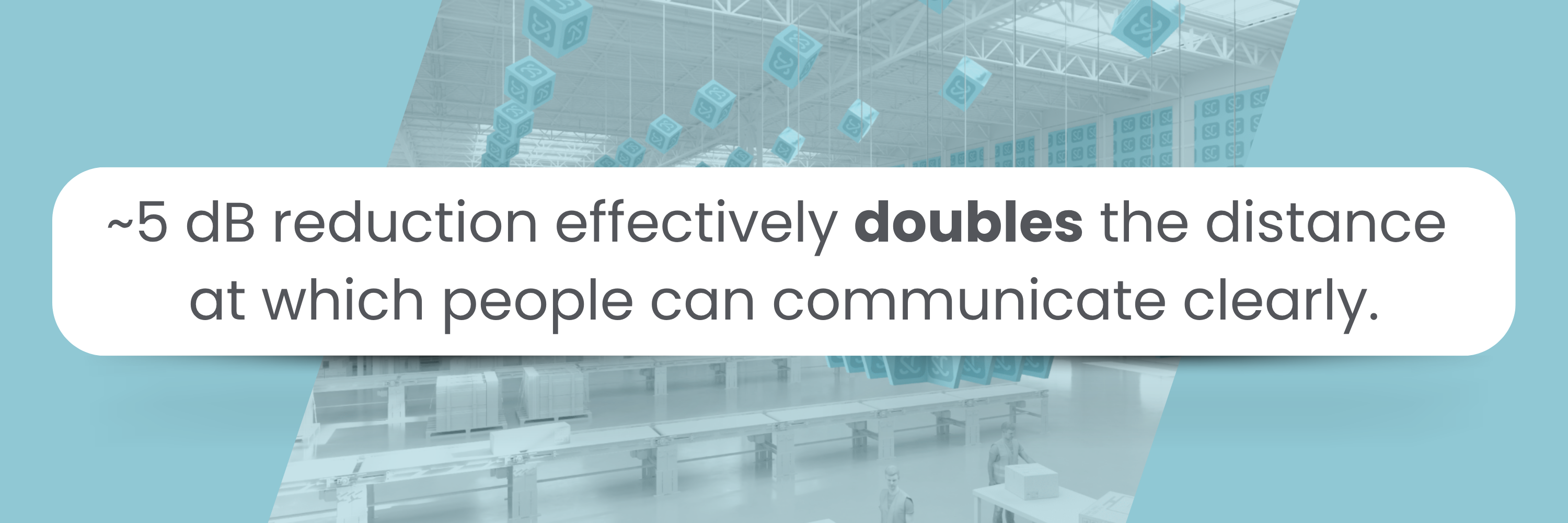
Here’s the important takeaway; a ~5 dB reduction doesn’t sound huge, but it can effectively double the distance at which people can communicate clearly. That’s the difference between constant frustration and smooth day-to-day operations. Download the “Distribution Center Noise Reduction” case study.
What Results Actually Matter
While decibel reduction is important (especially for internal justification), it's more about what people feel when they walk into the space. What your team will notice is:
- Easier communication
- Better employee comfort
- Fewer complaints
- Improved focus and coordination
And for decision-makers?
- Validated, measurable results that justify the investment.
For successful implementation, you need both.
THREE CRITICAL PIECES OF ADVICE FOR COMMERCIAL CONSTRUCTION FIRMS, FACILITY MANAGERS, & INDUSTRIAL HYGENISTS
1. Bring acoustics into the building design stage.
If you’re building or expanding a facility, address noise before it becomes a problem. Designing early for acoustics is significantly more efficient (and usually less expensive) than retrofitting later.
2. Don't wait too long to fix it.
Noise problems don’t stay contained. The longer you wait, the more it costs—operationally and culturally. Untreated noise problems lead to:
- Employee frustration
- More complaints (formal or informal)
- Potential turnover
- Communication breakdowns
3. Keep fire safety top of mind.
ASTM E84 Class A fire rating is the gold standard for acoustic materials.
The Bottom Line
Reducing noise in a large industrial space isn’t about throwing materials at the problem. It’s about understanding the environment, engineering the right solution, and validating the results.
If you do it right, ROI shows up across key areas like:
- Improved team communications
- Controlled environment vs. chaotic environment
- Smoother operations
Take the Next Step
Contact us!
Contact Soundcoat to begin your acoustic optimization journey, today!